Project 1 The Box


Project 1 – Boxed Mind

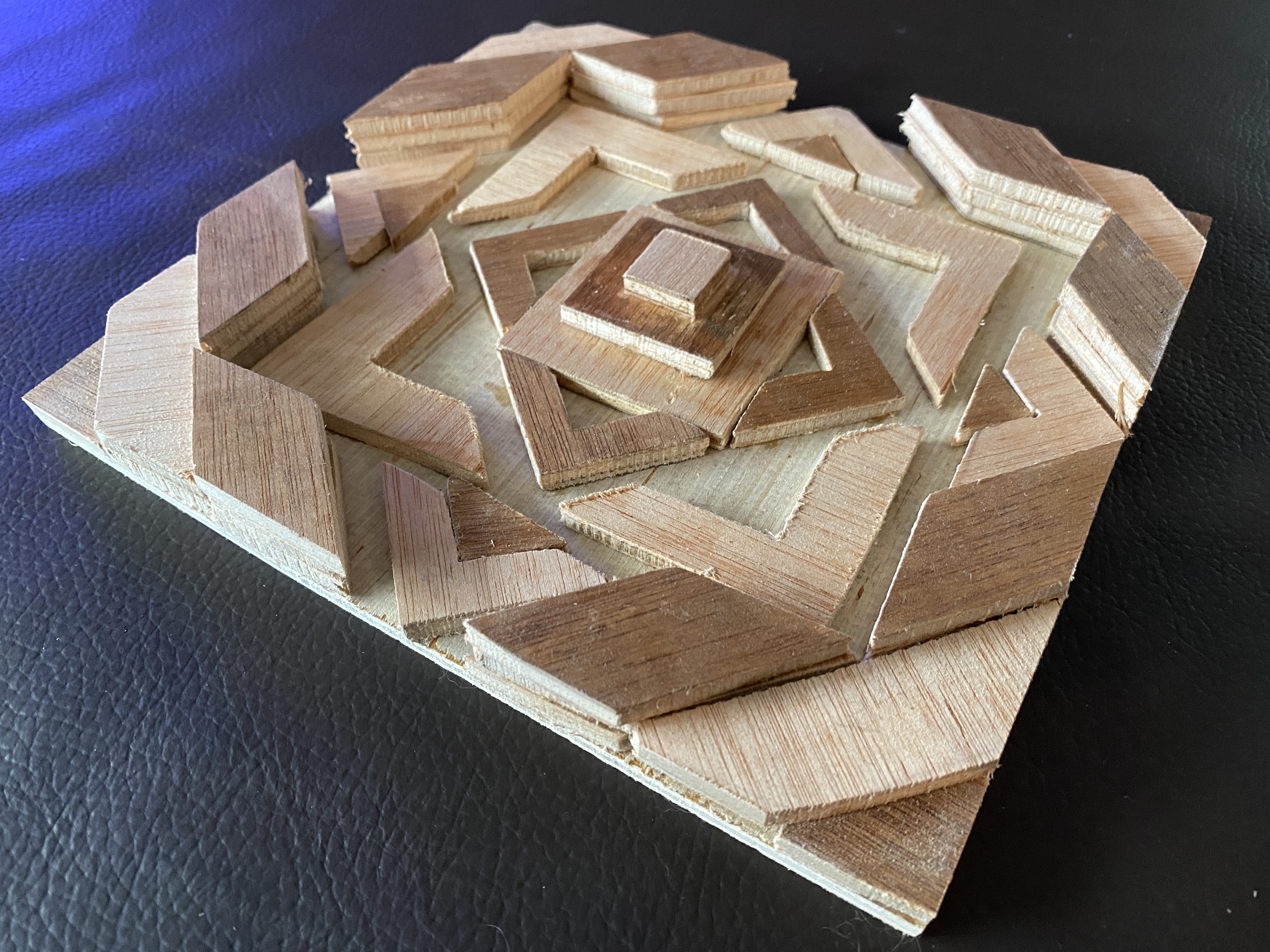
The box remains a central part of my art work, so I decided to look further into its meaning. The definition of a box is a container, which is an object that can be used to hold or transport something. Synonyms of a container are a vessel, a casket, and pottery. In this sense, one could consider the human mind a vessel that stores memories. This concept was intriguing and worthy of further development.

Focusing on this concept, the human mind became a space comprised of various compartments. Each compartment ranged from a single level to multiple levels. The multi-level compartment were for the more complex thoughts and feelings; places that needed more space to breathe.

As I planned the sculpture, I envisioned a mandala, made with various shaped boxes instead of circles. Originally thinking about using paper to sculpt, my vision began to change as I cut out each individual area. The piece needed to be more solid and sturdy, so I brought in the natural element of wood. Wood is a sustainable substance that lives, breathes, and dies similarly to the human body. The wood pieces can be scarred by knots, cut into so the wound weeps, and blown over by the wind. Through time is stands tall, it is resilient. Once it falls, it can be made into something beautiful and equally long lasting.

To make this piece, I traced the individual shapes onto flat thin pieces of wood. Each piece was then cut using the band-saw. The pieces were not uniform even though they came from the same shape. From out of the individually cut pieces, a multi-level design developed. Wood pieces were held together by glue, sanded down to remove the sharp splinters, and laid out onto the backboard. After the pieces were dry, I stained several to create a more in-depth appearance. The final step was to trim each of the sides to maintain a uniform composition and structure to the box. 


Comments

Popular posts from this blog

Intertwined - Grief and Hope

  2D Project - create an image using 2 objects in various sizes to simulate foreground and background fading out of view.  For this project I used two Willow Tree sculptures created by artist Susan Lordi to compose my project. As a military widow these two sculptures hold significant meaning. The foreground is composed of more Hero statues as it signifies more of the immediate grief after suffering loss. As you move toward the middle there is hope and grief mixed together. The background contains more hope then grief as you begin to find yourself again and move forward in your journey. Willow Tree Sculptures Hero and Soar Hero sculpture shadowed from various angles

Project 2 String Art

  Project 2 - String Art String Art dates back to the 1900's, it is art created by making designs with nails and colorful string. Mary Everest Boole is the first person to be given credit for making curves from straight lines contained within her art, which she used to explain math to her students. String Art later became the basis of the Bezier Curve. (String of The Art) Then John Eichinger was the first artist in the US to create what he called 'string mandalas' after the Hindu art form of circles within circles. (String Art Fun) For this project, I adapted this concept of mandalas that I previously used in Project 1, which was a mandala like wood sculpture but with a square base. For these designs I used frames that were found in the wood shop, small nails, and colorful string.  The basis for the designs were to show that even though a structure is created from a square, it can be turned into something else. My patterns were derived from squares but through the work of a...

Sculpture Assignment 1

For this project the criteria was to use an eight foot 2x2 piece of wood to create a formalist sculpture.  When creating this piece I wanted to a work of art that had a topsy turvy aesthetic. The bottom 2x2 is resting on a hard edge, while the other pieces connect off each side.  I cut and sanded out divots into the corner edges all along the interior angles of the wood. Each piece was sanded down to remove blemishes and to create a relatively smooth surface. To fasten the pieces together I used a countersink drill to make the initial holes and then drilled in two screws for each piece, creating stability. Once completely together, the divots were painted white and the remainder was painted black with acrylic paint. After drying, I made a design decision to scratch off the black layer to reveal the white underneath. Reminiscent of old country style, which goes against the more modern look of the overall piece.  If you look closely, one of the side pieces is attached diffe...